India’s payments landscape is evolving fast. Over the last few years, a big shift has taken place — RuPay, the homegrown card network, is rapidly becoming one of the most used credit card networks in the country. What’s driving this change? And why are RuPay credit cards suddenly capturing so much market share? Let’s unpack the story with the latest data and trends.
A Government-Led Vision
RuPay was conceived not as just another card brand, but as part of India’s strategic vision to build a self-reliant payment ecosystem. Launched in 2012 by the National Payments Corporation of India (NPCI) under RBI’s guidance, RuPay was meant to reduce dependency on global networks like Visa and Mastercard and make digital payments more accessible for all Indians.
A crucial milestone came in June 2022, when RBI allowed RuPay credit cards to be linked with UPI. This simple regulatory change was a game-changer — suddenly, credit cards could be used like UPI for QR scanning, exactly how people were already paying digitally.
UPI Integration: The Real Growth Engine
Before UPI integration, credit cards had limited reach — largely confined to POS machines in stores, or online payments. Consumers rarely used them for everyday small spends because the process was slower and less convenient.
UPI changed that. By enabling RuPay credit cards to be linked and used right within the UPI scan-and-pay flow, NPCI unlocked a huge behavioural shift. Users didn’t have to switch apps or change how they paid. They just chose credit instead of debit or bank balance — but still within the familiar UPI interface.
Within just a couple of years:
- UPI-linked RuPay credit card transactions doubled, moving from about 362.9 million in FY24 to around 750 million in FY25.
- These payments were valued at nearly ₹63,826 crore (~US$7.3B) by October FY25.
- Today, nearly 40% of all credit card payments by volume are routed over UPI, a dramatic shift from about 10% just a year earlier.
This growth reflects more than convenience — it reflects usage behaviour shifting toward daily, small-ticket credit usage, just like UPI has normalised digital payments. UPI isn’t just a payment rail anymore — it’s the preferred way most Indians pay.
Lower Cost & Better Acceptance for Merchants
Another big reason RuPay is gaining ground is cost dynamics for small merchants.
With UPI, many RuPay credit card transactions under ₹2,000 don’t attract a merchant discount rate (MDR) — a fee merchants typically pay on card transactions. This makes accepting credit via UPI much cheaper and attractive for neighbourhood shops and kiranas.
Compare that with traditional credit card swipes, where merchants often bear higher fees and need POS machines. With UPI QR codes already everywhere — over 50 million merchants accept UPI — RuPay credit cards instantly plug into that ecosystem.
This has major implications:
- Small merchants are more willing to accept credit spends.
- Users get to use credit just like UPI — no swipe machines required.
- RuPay naturally grows where traditional card networks often struggled.
Rapid Market Share Gains
These factors together are not just theoretical — they show up clearly in market numbers:
- RuPay’s share of India’s credit card market climbed to about 16-18% in late 2025 — a significant rise from just a few percentage points a couple of years ago.
- In just two years, RuPay credit card usage went from around 3% to roughly 16% of total credit card transactions.
This rapid climb reflects a structural shift. RuPay isn’t capturing a niche — it’s becoming a central part of India’s broader credit card ecosystem.
Why Consumers Love It
From a user’s perspective, RuPay credit cards are winning because they:
- Fit into habits people already have — UPI scan and pay is now second nature.
- Eliminate friction for small everyday spends, like groceries, fuel, medicines, or tea stall QR payments.
- Bring credit into everyday life, instead of reserving credit for big purchases.
- Offer wide acceptance, especially in areas where POS machines were historically rare.
In effect, RuPay introduces credit into the daily UPI flow without changing behaviour — and consumers have responded enthusiastically.
Where Kiwi Comes In
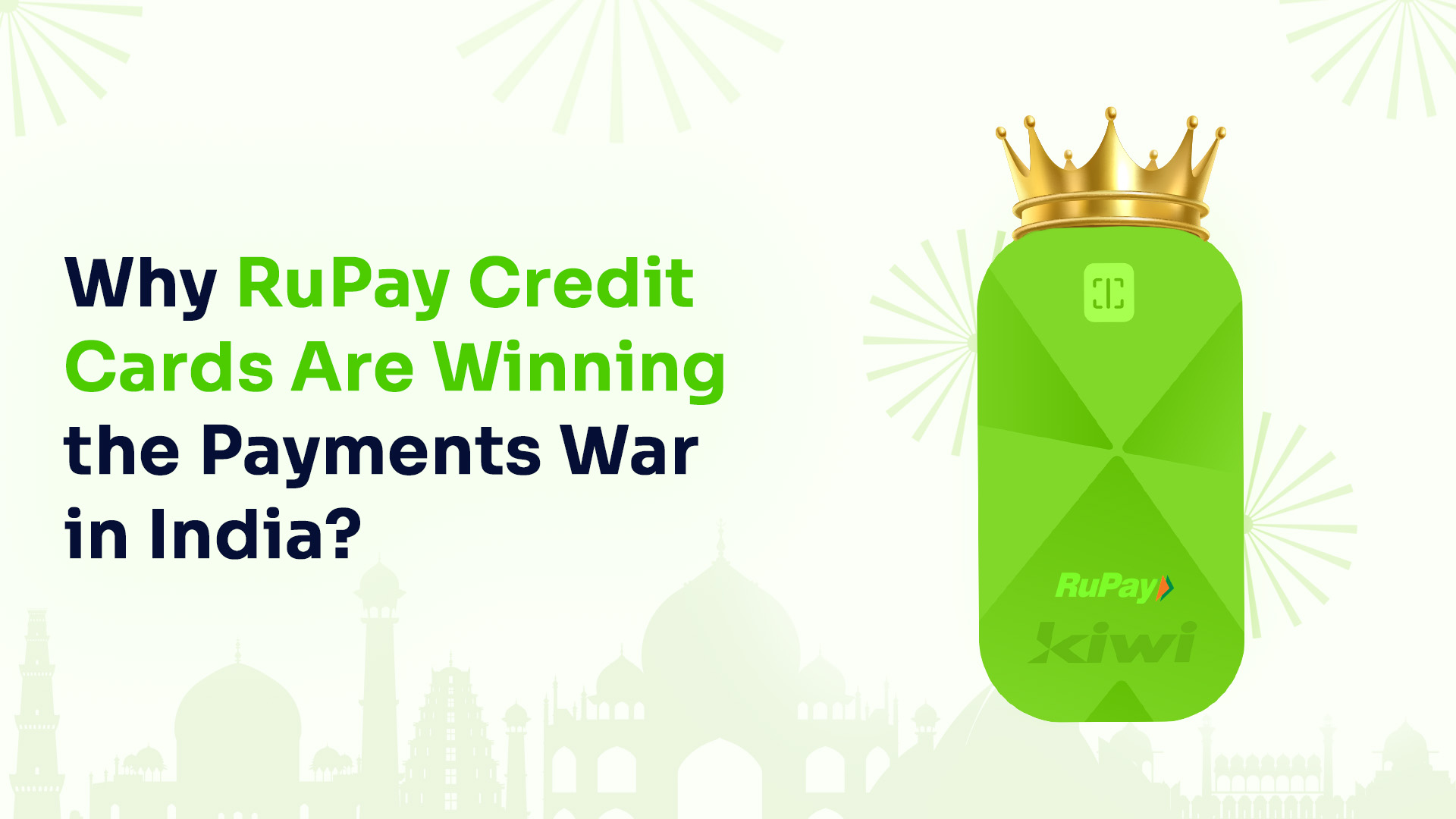
Kiwi is built as a RuPay-native, UPI-first credit card, born out of this exact transformation in payments. Kiwi leverages the wide acceptance of UPI and the growing comfort with credit-on-UPI behaviour to help users spend smarter every day.
Here’s how Kiwi fits into the winning formula:
- Seamless UPI integration: Pay by scanning QR codes — just like UPI.
- RuPay network advantage: Benefit from lower merchant costs and wider small-merchant acceptance.
- Everyday credit: Makes credit usable for daily transactions, not just big spends.
- Trackable and disciplined spending: You see all transactions in one place, helping manage budgets better.
By combining UPI’s ease with RuPay’s rapid market growth, Kiwi makes everyday credit simple and practical — a powerful combination in 2026’s payment environment.
The Bottom Line
RuPay credit cards are winning because they combine policy support, smart integration with India’s dominant payment system (UPI), and real merchant advantage. They aren’t just another card on the block — they’re redefining credit usage for millions.
As UPI continues to be the backbone of Indian digital payments, and RuPay continues to ride that wave, credit cards will no longer be exclusive to big spends — they’ll be part of everyday life. And that’s the real win in the payments war.