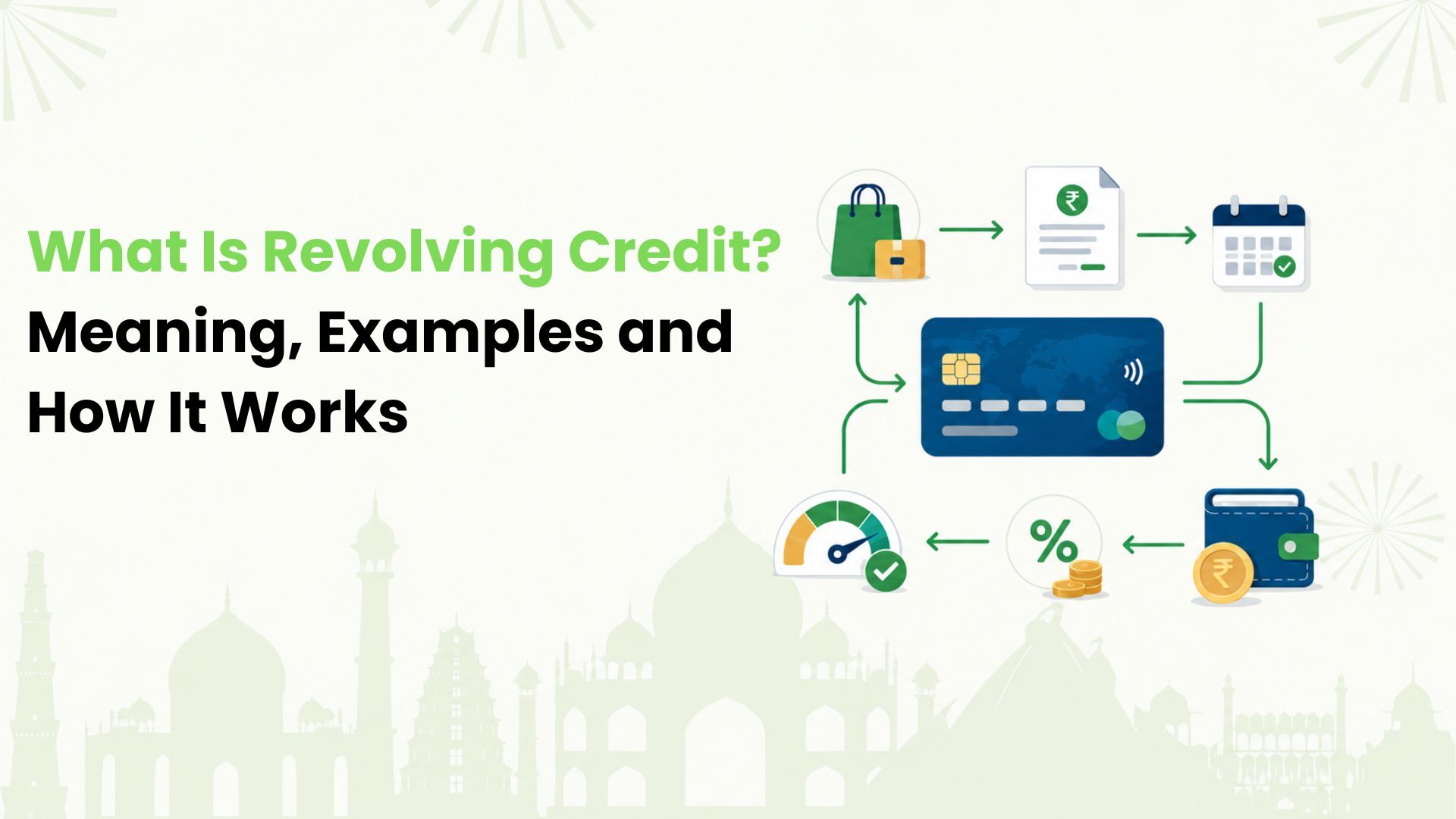
Revolving credit is a reusable borrowing facility that lets Indian consumers spend up to an approved credit limit, repay what they use and access that amount again. A credit card is the most familiar example. Unlike a regular loan, you do not receive one fixed sum with a fixed repayment schedule.
This flexibility can make everyday payments easier. However, carrying an unpaid balance can attract high interest charges, so it is important to understand the cycle before using it.
The Credit Limit, Spending and Repayment Cycle
A lender approves a maximum credit limit for the account. Every purchase or withdrawal reduces the amount still available. When you repay part or all of the outstanding balance, the corresponding amount becomes available again.
Suppose your credit card has a limit of ₹60,000:
- You spend ₹15,000, leaving ₹45,000 available.
- You repay ₹10,000, subject to any pending charges or transactions.
- Your available credit rises to about ₹55,000.
- You can use the restored limit again while the account remains active and in good standing.
The amount you owe and the payment required can change each month based on how much you spend, repay and carry forward.
Do You Pay Interest on Revolving Credit?
Interest depends on the product terms and how you repay. With a credit card, you can generally retain the interest-free credit period by paying the entire amount due by the due date. Check the issuer’s Most Important Terms and Conditions (MITC) for the exact annualised percentage rate (APR), fees and calculation method.
If you pay only the minimum amount due, the account may not be treated as overdue, but the unpaid balance can continue to attract interest charges. The Reserve Bank of India warns that repeated minimum-only payments may extend repayment for months or years. An earlier unpaid balance can also suspend the interest-free period on new transactions.
The minimum amount due is therefore a payment requirement, not a low-cost repayment plan.
Common Examples of Revolving Credit
Credit Cards
Credit cards provide a reusable limit for eligible purchases and, where permitted, cash advances. Most consumer credit cards are unsecured, which means they are not backed by a specific asset. Cash advances may carry separate fees and interest rules.
Personal Lines of Credit
A personal line of credit allows approved borrowers to draw funds when required, up to the available limit. Access, pricing and repayment rules vary by lender.
Overdraft Facilities
An overdraft lets an eligible bank account go below its available balance up to an approved limit, subject to the facility’s terms.
Revolving Credit Versus Instalment Credit
| Feature | Revolving credit | Instalment credit |
| Access to funds | Reusable up to the available limit | Usually paid once as a lump sum |
| Repayment | Varies with usage and the outstanding balance | Usually fixed payments over a set tenure |
| End date | May remain open until closed or withdrawn | Ends after the scheduled repayment period |
| Interest | Usually applies to the balance carried, as per terms | Usually applies according to the loan schedule |
| Common examples | Credit cards, lines of credit and overdrafts | Home, vehicle and personal loans |
Revolving credit suits repeat or changing needs. Instalment credit is generally designed for a defined amount and repayment period.
Benefits and Risks of Revolving Credit
The main benefit is reusable access. Repayment restores the limit, and you decide how much to use. Credit cards can also make online, in-store and eligible merchant UPI payments convenient, while some products offer cashback or Reward Points on eligible transactions.
The same flexibility can encourage overspending. Interest may make carried balances expensive, minimum payments can prolong debt, and annual, late-payment or cash-advance fees may apply. Available credit should never be treated as extra income.
How Does Revolving Credit Affect your Credit Score?
TransUnion CIBIL lists payment history and credit utilisation among the main factors that affect a credit profile. Credit utilisation is the share of your available revolving limit that you are currently using.
For example, a ₹20,000 balance across total card limits of ₹80,000 represents 25% utilisation. Using a large share of the limit can suggest greater dependence on borrowed funds. Paying on time, keeping balances manageable and avoiding frequent applications can support healthier credit behaviour, although scoring models and lender decisions vary.
How to Manage Revolving Credit Responsibly
- Plan to pay the full amount due when the interest-free period applies.
- Track spending and available credit instead of waiting for the statement date.
- Keep utilisation manageable and leave room for genuine needs.
- Set payment reminders or auto-pay, with enough money in the linked account.
- Read the MITC and statement for the APR, fees, due date and minimum amount due.
Bring Revolving Credit to Everyday Merchant Payments with Kiwi
A RuPay credit card linked to UPI is also backed by a revolving credit limit. With Kiwi, you can use an eligible RuPay credit card to scan and pay at supported merchant QR codes, view transactions and manage card payments in the app. This flow is for supported merchant payments only. It does not support peer-to-peer transfers or restricted uses such as lending-platform payments, mutual funds, ATM cash withdrawals and IPO payments. Check the current issuer and UPI terms for the full list.
The best reward is control: know what you have spent, aim to clear the full amount due and let your limit refresh without avoidable interest. Ready to put your credit line to practical use? Explore UPI on credit with Kiwi and check the current eligibility, card and rewards terms.
FAQs
Is revolving credit the same as a credit card?
No. A credit card is one type. Personal lines of credit and overdrafts can also be revolving.
Is it compulsory to use the full credit limit?
No. The limit is the maximum amount available, not a spending target. You can use only what you need and can repay.
Does paying the minimum amount due stop interest?
Usually not. Interest can continue on the unpaid balance. Paying the entire amount due is generally required to retain the interest-free period.
Can revolving credit improve a CIBIL Score?
Responsible use can support a healthy credit profile, but no action guarantees a higher score. Payment history, utilisation, age of credit and enquiries can all matter.
Is revolving credit suitable for long-term borrowing?
It is usually better suited to flexible, short-term needs. For longer repayment, compare its total cost with an instalment loan.
Disclaimer: The information provided in this article is for general informational and educational purposes only and should not be considered financial, credit, or investment advice. Revolving credit features, credit limits, interest rates, interest-free periods, minimum payment requirements, fees, eligibility criteria, and repayment terms vary by lender and product. Credit card and UPI on credit features are subject to applicable issuer, bank, NPCI, and product terms. Responsible use of credit may support a healthy credit profile, but no repayment or spending strategy guarantees an improvement in your credit score or approval for future credit. Kiwi-related information is subject to applicable eligibility criteria, partner-bank requirements, product terms, conditions, and rewards policies. Users should review the latest MITC, account terms, and applicable policies before making borrowing or repayment decisions.