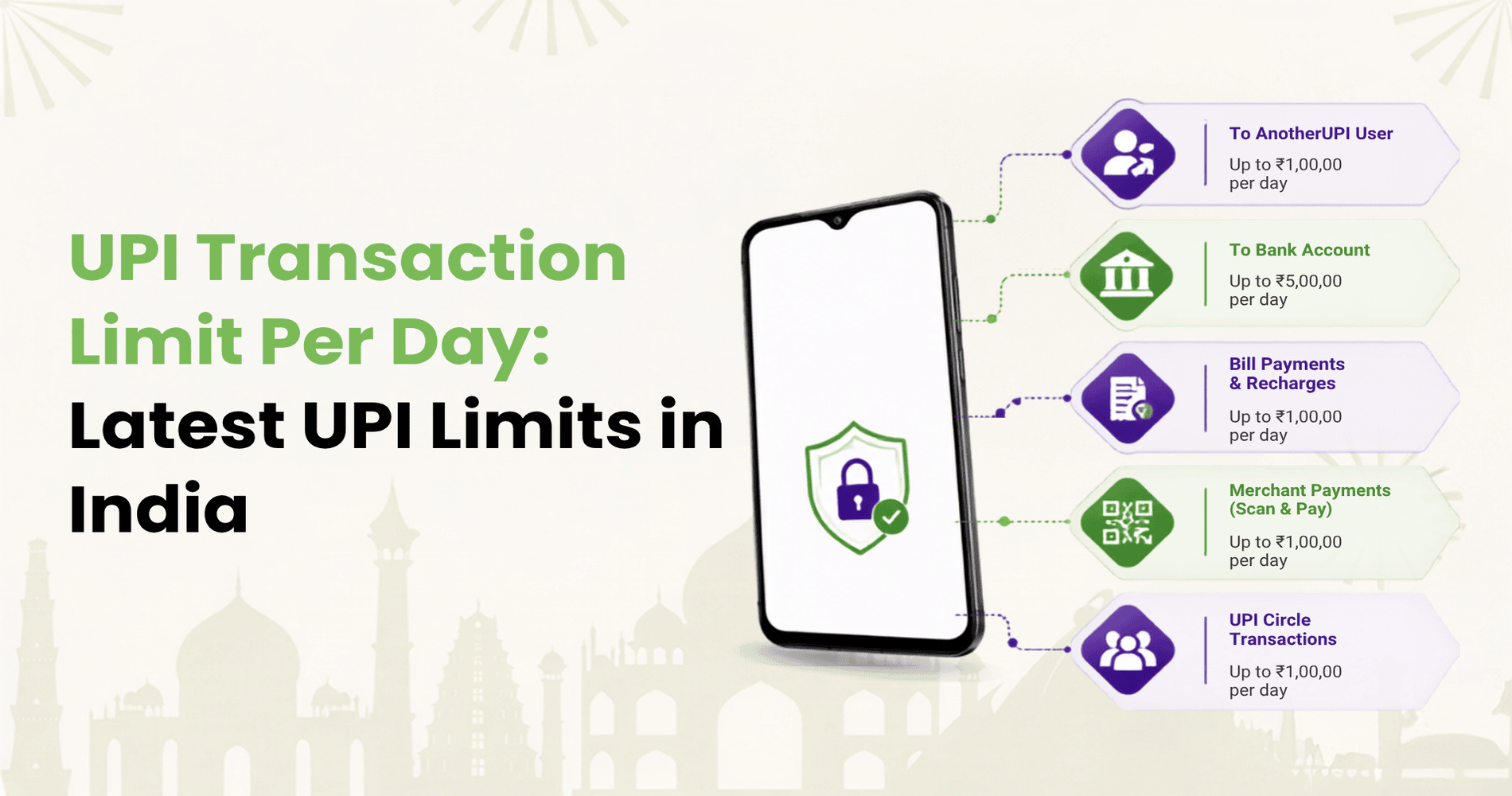
UPI transaction limit rules matter when you are paying rent, clearing a bill, shopping, sending money, or using a RuPay credit card on UPI for everyday merchant payments. In most cases, the standard UPI limit is up to ₹1 lakh per day. But the actual limit you get can change based on your bank, UPI app, account type, transaction count, merchant category, and whether you are using normal UPI, UPI Lite, UPI 123Pay, or credit card on UPI.
This guide explains the latest UPI transaction limits in India in simple terms, including bank-wise limits, special high-value categories, UPI Lite limits, RuPay credit card on UPI limits, and what to do when a payment fails even though you have enough balance.
Quick answer: what is the UPI transaction limit per day?
For most Indian users, the standard UPI transaction limit per day is up to ₹1 lakh. This usually applies across UPI apps linked to the same bank account. Your bank may allow a lower limit, and some transaction categories may qualify for a higher limit when the merchant is registered under the right category.
| UPI use case | Typical limit |
|---|---|
| Standard UPI transaction | Up to ₹1 lakh per day |
| Standard UPI transaction count | Usually up to 20 transactions per day |
| Select high-value categories | Up to ₹5 lakh per transaction |
| Some approved high-value categories | Up to ₹10 lakh in a 24-hour period |
| UPI 123Pay | Up to ₹10,000 per transaction |
| UPI Lite | Up to ₹1,000 per transaction |
| UPI Lite wallet balance | Up to ₹5,000 |
| RuPay credit card on UPI | Usually governed by bank, card, app, and merchant limits |
These are broad limits. The final limit for your payment can be lower if your bank, card issuer, UPI app, merchant category, or fraud-risk controls apply a stricter rule.
How UPI transaction limits work
UPI limits are not decided by just one app. They work in layers.
First, NPCI sets the broad framework for UPI transaction limits in India. Second, banks and issuers apply their own risk rules within that framework. Third, UPI apps may show or enforce limits based on the bank account or card you have linked. Finally, the merchant category can decide whether a higher-value payment is allowed.
That is why two people using the same UPI app may see different limits. One user may have a ₹1 lakh daily limit, while another may face a lower cap because of bank policy, account type, new-user restrictions, card controls, or transaction-risk checks.
Standard UPI limit per day
For regular UPI payments, the commonly used daily limit is up to ₹1 lakh. This includes many person-to-person transfers and everyday merchant payments. In addition to the amount limit, many banks and UPI apps also apply a count limit, commonly around 20 transactions per day.
The amount limit and count limit are separate. For example, if you make 20 small UPI payments of ₹200 each, you may still hit the transaction count limit even though you have spent only ₹4,000. Similarly, if you make one large payment close to ₹1 lakh, you may hit the amount limit even though you have made only one transaction.
This is why UPI payment failures can feel confusing. A failed transaction does not always mean low balance. It can also mean your bank has blocked the transaction because of a daily cap, per-transaction cap, count cap, new-user cap, merchant rule, or security check.
Bank-wise UPI transaction limits
Bank-wise UPI limits vary across India. Many large banks support up to ₹1 lakh per transaction and ₹1 lakh per day for regular UPI transfers. Some banks may set a lower per-transaction cap while keeping a higher daily cap. Co-operative banks, regional rural banks, payments banks, and small finance banks can also have different limits.
Here is a simplified view for commonly searched banks and account types.
| Bank or account type | Common UPI transaction limit | Common daily limit |
|---|---|---|
| SBI | Up to ₹1 lakh | Up to ₹1 lakh |
| HDFC Bank | Up to ₹1 lakh | Up to ₹1 lakh |
| ICICI Bank | Up to ₹1 lakh | Up to ₹1 lakh |
| Axis Bank | Up to ₹1 lakh | Up to ₹1 lakh |
| Kotak Mahindra Bank | Up to ₹1 lakh | Up to ₹1 lakh |
| YES Bank | Up to ₹1 lakh | Up to ₹1 lakh |
| IDFC FIRST Bank | Up to ₹1 lakh | Up to ₹1 lakh |
| AU Small Finance Bank | Up to ₹1 lakh | Up to ₹1 lakh |
| Some co-operative and RRB accounts | Can be lower | Can be lower |
Always check the limit inside your UPI app or banking app before making a large transfer. Your personal account limit may differ from the public bank-wise limit because banks can apply controls based on account age, KYC status, risk rules, and transaction history.
Do app-wise UPI limits differ?
Yes, but app-wise limits are still connected to your bank account or card. Google Pay, PhonePe, Paytm, BHIM, Kiwi, and other UPI apps may show different user interfaces, but they do not create unlimited separate limits for the same bank account.
If your bank account has already hit its UPI cap for the day, switching from one UPI app to another may not solve the issue. The limit is usually tracked at the bank-account level or instrument level, not only at the app level.
However, app experience still matters. A good UPI app can help you understand payment status, see transaction history, manage linked accounts or cards, and choose the right payment instrument for the use case.
Higher UPI limits for special categories
Some UPI payments can go beyond the standard ₹1 lakh limit. These higher limits are meant for approved high-value use cases and usually depend on the merchant being correctly registered under the relevant category.
Common higher-limit categories include:
- Tax payments
- Government payments
- Education fees
- Hospital and healthcare payments
- Insurance premiums
- Capital market payments
- IPO applications
- RBI Retail Direct payments
- Credit card bill payments
- Loan collections and EMI payments
- Travel payments, where supported
For several of these categories, the limit can go up to ₹5 lakh per transaction. In some approved high-value merchant categories, the daily limit can go up to ₹10 lakh in a 24-hour period.
The important point is that the higher limit is not automatic for every user and every merchant. Your bank must allow it, your UPI app must support it, and the merchant must be registered under the correct category. If a hospital, college, insurer, or tax payment fails above ₹1 lakh, the issue may be related to category registration or bank controls rather than your account balance.
UPI Lite transaction limit
UPI Lite is designed for small, frequent payments. It uses a separate wallet-style balance, so small payments can be faster and may not need a UPI PIN each time.
The UPI Lite per-transaction limit is up to ₹1,000, and the UPI Lite wallet balance limit is up to ₹5,000. This makes it useful for low-value purchases like snacks, tea, local travel, parking, or small shop payments.
UPI Lite is not meant for large transfers. It works best when you want to avoid using regular UPI for every tiny payment and keep your standard UPI limit available for bigger spends.
UPI 123Pay transaction limit
UPI 123Pay is meant for feature phone users and people who may not have regular smartphone internet access. The per-transaction limit for UPI 123Pay is up to ₹10,000.
This helps users make digital payments through supported feature-phone flows such as IVR, missed call, and other assisted modes. It is useful in areas where smartphone access, mobile data, or app comfort may be limited.
RuPay credit card on UPI transaction limit
RuPay credit card on UPI lets eligible users link a RuPay credit card to a UPI app and pay merchants through UPI. This is different from using UPI from a savings account. The money is drawn from your credit card limit instead of your bank balance.
For RuPay credit card on UPI, limits can depend on:
- NPCI rules for credit card on UPI
- Your issuing bank or partner bank
- Your card limit
- Your UPI app
- Merchant type
- Merchant category code
- Risk and security checks
For regular merchant payments, a broad daily UPI limit may still apply. But credit card on UPI can also have additional merchant-level rules. For example, Kiwi explains that NPCI checks can apply to small-merchant credit card transactions below ₹2,000. In a rolling 24-hour period, the total amount of such transactions to small merchants can be capped at ₹2,000, or ₹4,000 on weekends. These checks apply only to merchants categorised as small by NPCI, and not to large merchants or transactions above ₹2,000.
This is useful to know because a credit card on UPI transaction may fail even when your card limit is available. The reason could be a small-merchant limit, not a problem with your card.
Why your UPI payment may fail even within the limit
A UPI payment can fail for several reasons beyond available balance. The most common reasons are:
- You crossed your daily UPI amount limit.
- You crossed the daily transaction count limit.
- Your bank has a lower cap than the standard limit.
- You recently registered or changed UPI settings.
- The merchant category does not support the higher limit.
- The payment is being made through RuPay credit card on UPI and a credit-card-specific check applies.
- The UPI app or bank has flagged the transaction for risk review.
- The recipient bank or payment system is temporarily unavailable.
- You entered the wrong UPI PIN.
- Network or app issues interrupted the transaction.
If the amount is urgent, check the exact failure message. Then try a different payment method such as net banking, debit card, NEFT, IMPS, or another bank account if appropriate. Avoid repeating the same failed transaction too many times, as repeated attempts can trigger more risk checks.
How to check your UPI transaction limit
You can usually check your UPI limit in three places.
First, open your UPI app and go to your linked bank account or payment profile. Many apps show transaction limits, linked accounts, and payment settings there.
Second, check your bank’s mobile banking app or net banking dashboard. Banks often show UPI limits under fund transfer, payments, cards, or security settings.
Third, contact your bank if the app does not show a clear limit. This is especially useful for new accounts, current accounts, co-operative bank accounts, regional rural bank accounts, or cases where you recently changed your device, SIM, UPI PIN, or linked account.
For RuPay credit card on UPI, also check your credit card limit and card controls. Your available credit limit and UPI transaction limit are related, but they are not the same thing.
UPI transaction limit for everyday merchant payments
Most users do not hit the ₹1 lakh UPI limit every day. The limit becomes important when you are making a larger payment or many small payments in a short period.
For everyday merchant payments such as groceries, food delivery, pharmacy bills, local shopping, utilities, and QR payments, UPI is usually well within the standard limit. The bigger question is which payment instrument you want to use.
If you use savings-account UPI, the money leaves your bank account instantly. If you use a RuPay credit card on UPI, you can pay eligible merchants through UPI while using your credit card limit. That can help you keep bank balance free for other needs, consolidate spends on your card statement, and earn eligible rewards or cashback where applicable.
Where Kiwi fits in
Kiwi is built for users who want to use UPI on credit for everyday merchant payments. With a RuPay credit card issued via the Kiwi app, eligible users can scan and pay merchants through UPI, manage payments in the app, and earn cashback on eligible QR payments.
Kiwi keeps the experience practical: apply through the app, complete the application process, and get access to a digital card upon approval. The card issued depends on your credit score and partner-bank requirements.
For users who make frequent QR payments, this can turn routine UPI spends into something more useful. You still need to stay within UPI, bank, card, merchant, and eligibility limits. But when the transaction is eligible, Kiwi helps you pay merchants via UPI using credit and track the payment from one app.
Conclusion
The standard UPI transaction limit per day in India is up to ₹1 lakh for most regular payments. But that is only the starting point. Your real limit can depend on your bank, UPI app, account type, transaction count, merchant category, UPI Lite usage, UPI 123Pay flow, and whether you are using a RuPay credit card on UPI.
If you are planning a large payment, check your bank or app limit first. If you are making daily merchant payments, choose the payment instrument that fits the use case.
Want your everyday UPI QR payments to work harder? Download Kiwi, apply in minutes, and use a RuPay credit card on UPI for eligible merchant payments while earning cashback where applicable.
FAQs
What is the UPI transaction limit per day?
The standard UPI transaction limit per day is up to ₹1 lakh for most regular UPI payments. Your bank, UPI app, account type, and merchant category can set a lower or different effective limit.
How many UPI transactions can I do in a day?
Many banks and UPI apps allow around 20 UPI transactions per day. The exact count can vary by bank, app, account type, and risk controls.
Can I transfer more than ₹1 lakh through UPI?
Yes, but only for select approved categories such as tax payments, education, healthcare, insurance, capital markets, IPO, RBI Retail Direct, government payments, credit card bill payments, travel, or loan collections. The merchant must be registered under the correct category, and your bank must allow the transaction.
What is the UPI Lite limit?
The UPI Lite per-transaction limit is up to ₹1,000, and the wallet balance limit is up to ₹5,000. It is meant for small, frequent payments.
What is the UPI 123Pay limit?
The UPI 123Pay per-transaction limit is up to ₹10,000. It is designed mainly for feature phone users and assisted UPI payment flows.
Is the RuPay credit card on UPI limit different?
RuPay credit card on UPI limits can depend on NPCI rules, the issuing bank, your card limit, UPI app rules, merchant category, and risk checks. Some small-merchant checks can apply separately to credit card on UPI transactions.
Why did my UPI payment fail even though I had money?
Your payment may have failed because you crossed your daily amount limit, transaction count limit, bank limit, app limit, merchant-category limit, or a risk-control check. For credit card on UPI, card and merchant-specific checks may also apply.
Does switching UPI apps increase my limit?
Usually, no. If the limit is applied at the bank-account or card level, switching apps will not reset it. You should check the limit for your linked bank account or card.
Can I use Kiwi for all UPI payments?
Kiwi can help eligible users pay merchants through UPI using a RuPay credit card issued via the Kiwi app. It is meant for eligible merchant payments and does not mean every UPI transaction type, merchant, or user will qualify.
Disclaimer: The information provided in this article is for general informational and educational purposes only and should not be considered financial, credit, banking, or payment advice. UPI transaction limits, transaction-count limits, UPI Lite limits, UPI 123Pay limits, RuPay credit card on UPI limits, and higher limits for specific merchant categories may vary based on NPCI guidelines, banks, card issuers, UPI apps, account types, merchant category codes, user eligibility, risk controls, and applicable regulatory requirements. Bank-wise and category-specific limits mentioned in the article are indicative and may change from time to time. A transaction within a stated limit is not guaranteed to be processed successfully, as additional security, fraud-prevention, technical, merchant, or issuer-level restrictions may apply. Kiwi-related features, RuPay credit card availability, cashback, rewards, transaction eligibility, and payment limits are subject to partner-bank requirements, NPCI guidelines, user eligibility, and applicable product terms and conditions. Users should verify the latest limits and terms with their bank, card issuer, UPI service provider, NPCI, or relevant financial institution before making high-value or time-sensitive transactions.