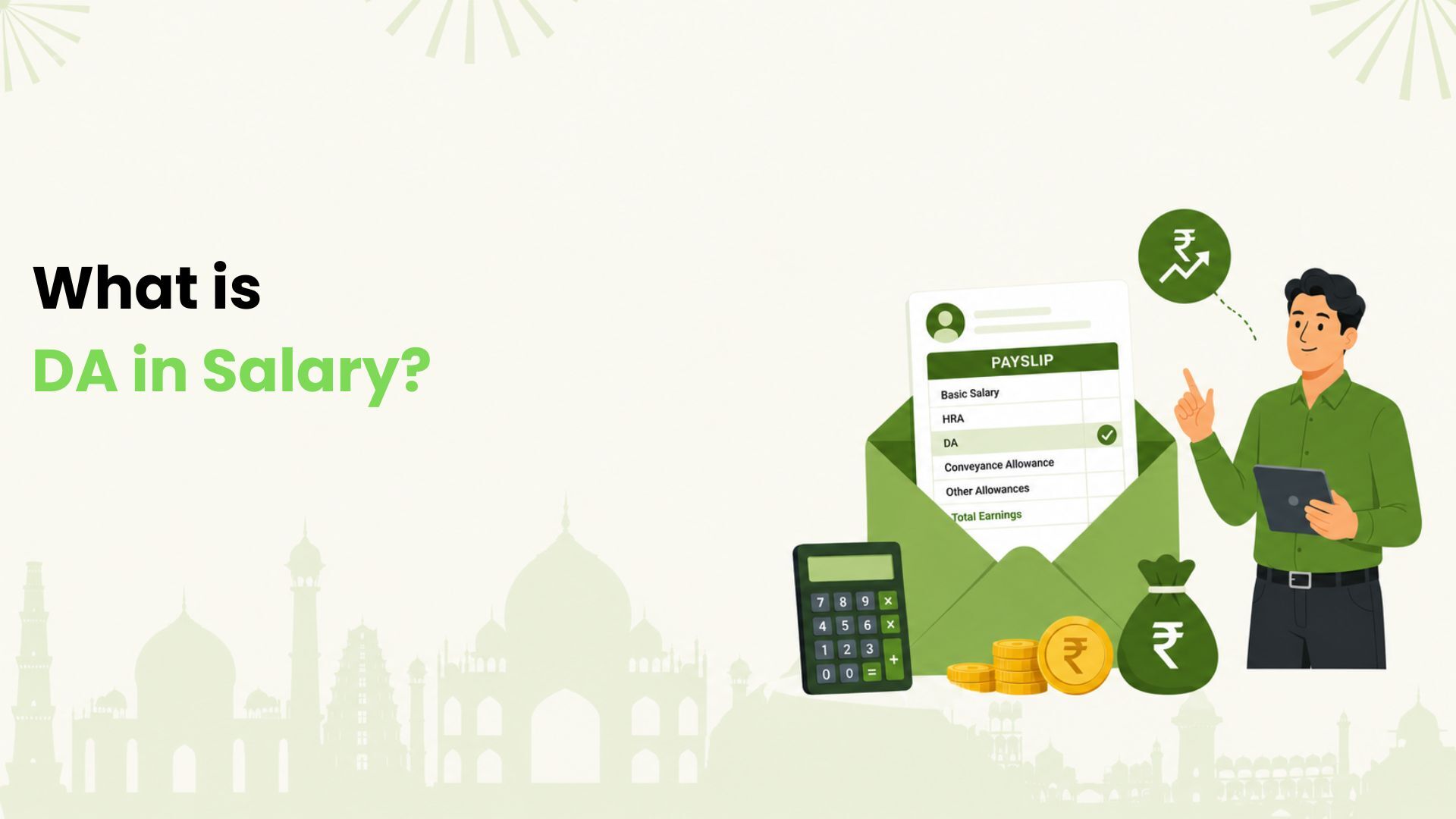
DA in salary means Dearness Allowance, an inflation-linked amount paid with basic salary. For Indian salaried employees, especially government employees, public sector employees and pensioners, DA helps protect monthly income when the cost of everyday goods and services rises.
In simple words, DA is a cost-of-living adjustment. It is usually calculated as a percentage of basic pay or basic pension. When inflation rises, the DA rate may be revised so that employees and pensioners can maintain their purchasing power more comfortably.
DA meaning and how it works
The full form of DA is Dearness Allowance. It is a salary component paid to offset the impact of inflation on an employee’s income.
DA is most commonly associated with Central Government employees, State Government employees, public sector employees and pensioners in India. Some private-sector companies may also use a similar allowance in their salary structure, but it is not as standardised as government DA.
For example, if your basic pay is ₹40,000 and the applicable DA rate is 60%, your DA amount will be ₹24,000. This DA is added to your salary along with other components such as basic pay, HRA, special allowance and other applicable benefits.
Current DA rate in 2026
As of the latest Central Government revision available at the time of writing, Dearness Allowance for Central Government employees was increased from 58% to 60% of basic pay with effect from 1 January 2026. Dearness Relief for pensioners was also revised in line with this change.
This rate applies to eligible Central Government employees under the relevant pay structure. State governments, public sector undertakings and other employers may follow their own rules, timelines and approval processes.
Because DA rates can change, always check your latest salary slip, employer circular or official government notification before using a rate for financial planning.
How is DA calculated in salary?
DA is generally calculated as a percentage of basic pay. The simple salary-level formula is:
DA amount = Basic pay x DA rate / 100
So, if your basic pay is ₹50,000 and the DA rate is 60%, the calculation will be:
₹50,000 x 60 / 100 = ₹30,000
Your DA amount will be ₹30,000 for that month, before applicable tax and deductions.
The government does not set the DA percentage randomly. It is linked to inflation indicators such as the Consumer Price Index for Industrial Workers, commonly called CPI-IW or AICPI-IW. The exact formula can differ depending on the employee category, pay commission rules and sector.
DA calculation example
Here is a simple example to understand how DA changes take-home salary.
Suppose an employee has:
| Component | Amount |
|---|---|
| Basic pay | ₹45,000 |
| Earlier DA rate | 58% |
| Revised DA rate | 60% |
At 58%, DA = ₹45,000 x 58 / 100 = ₹26,100
At 60%, DA = ₹45,000 x 60 / 100 = ₹27,000
Monthly increase in DA = ₹900
This does not mean the employee’s final take-home pay will rise by exactly ₹900. Income tax, provident fund rules, pension contributions and other deductions may affect the net salary credited to the bank account.
Types of Dearness Allowance
DA is often explained through two broad categories: Variable Dearness Allowance and Industrial Dearness Allowance.
Variable Dearness Allowance
Variable Dearness Allowance, or VDA, is generally linked to Central Government employees. It changes periodically based on inflation-related index movement. The objective is to keep employee income aligned with the cost of living.
VDA usually depends on:
- A fixed base index
- The latest Consumer Price Index movement
- Government-approved revision rules
Industrial Dearness Allowance
Industrial Dearness Allowance, or IDA, is generally linked to public sector employees and certain industrial wage structures. It is revised more frequently than many other allowances and is also connected to inflation data.
The exact rate and calculation method can vary by sector, employer and pay structure.
Who gets DA?
DA is mainly paid to:
- Central Government employees
- State Government employees
- Public sector employees
- Eligible pensioners and family pensioners
- Some employees in organisations that still use DA-linked salary structures
Private-sector employees do not automatically receive DA. Many private companies use other salary components such as special allowance, flexible benefits, performance pay or cost-to-company adjustments instead of a formal DA line item.
If you work in the private sector and see DA on your salary slip, ask your HR team how it is calculated and whether it affects retirement benefits, HRA calculation or any other payroll component.
Why DA matters in salary
DA matters because inflation affects everyday expenses. Groceries, transport, utilities, school fees, fuel and household costs can rise over time. If salaries stay fixed while prices rise, employees lose purchasing power.
DA helps in three ways:
- It supports purchasing power: DA gives employees extra income when inflation rises.
- It makes salary structures more responsive: Government and public sector salary structures can be revised without changing basic pay every month.
- It supports pensioners: Dearness Relief helps pensioners manage rising costs after retirement.
DA is not a bonus or a one-time reward. It is a recurring allowance tied to cost-of-living changes.
DA vs HRA: What is the difference?
DA and HRA are both salary components, but they serve different purposes.
| Basis | DA | HRA |
|---|---|---|
| Full form | Dearness Allowance | House Rent Allowance |
| Purpose | Helps offset inflation | Helps with rented housing costs |
| Calculation | Usually a percentage of basic pay | Depends on salary, rent paid, city and tax rules |
| Commonly paid to | Government and public sector employees | Public and private sector employees |
| Tax treatment | Fully taxable as salary | Partly exempt if conditions are met |
| Revision | Revised periodically based on inflation rules | Usually changes when salary or rent details change |
The easiest way to remember the difference is this: DA is linked to inflation, while HRA is linked to rent.
Is DA taxable?
Yes. DA is fully taxable for salaried employees in India. It is treated as part of salary income and taxed according to the applicable income tax slab.
This means DA should be included while calculating gross salary, taxable income and tax deducted at source. If you receive DA, it may also matter for certain calculations related to retirement benefits, HRA exemption or other payroll-linked components, depending on your employment terms.
For exact tax treatment in your case, check your Form 16, salary slip and employer payroll policy. You can also consult a tax professional if your salary structure includes multiple allowances.
Role of Pay Commissions in DA
Pay Commissions review salary structures for Central Government employees. Their recommendations influence basic pay, pay matrix structures, allowances and the framework used for DA revisions.
The 7th Central Pay Commission shaped the current pay matrix and many allowance-related rules. DA revisions after that are generally announced as a percentage of basic pay under the accepted formula.
This is why DA is closely watched by government employees and pensioners. A small percentage increase can affect monthly income for lakhs of people.
How to read DA in your salary slip
If DA applies to you, it usually appears on the earnings side of your salary slip. Look for terms such as:
- Dearness Allowance
- DA
- Industrial DA
- Variable DA
- Dearness Relief, if you are checking pension details
To understand the number, compare it with your basic pay. If your basic pay is ₹35,000 and DA is ₹21,000, the DA rate is 60%.
You can calculate it as:
DA rate = DA amount / Basic pay x 100
In this example:
₹21,000 / ₹35,000 x 100 = 60%
What DA means for monthly budgeting
DA can increase your gross salary, but it should not be treated as extra money without a plan. Since DA is taxable and may be revised in future, it is better to use it thoughtfully.
You can consider using DA increases to:
- Cover rising grocery and utility bills
- Increase emergency savings
- Repay high-interest dues faster
- Add more to long-term investments
- Keep everyday spending within a monthly budget
The idea is simple: DA helps your income respond to inflation, but your spending habits still decide how much value you get from that income.
Make your everyday salary spends work harder with Kiwi
Once you understand salary components like DA, the next step is managing everyday payments with more clarity. Kiwi helps eligible users pay merchants through UPI using a RuPay credit card, so daily scan-and-pay transactions can be handled through an app-led credit experience.
With Kiwi, users can make eligible merchant payments, track transactions and access applicable cashback or rewards based on product and offer terms. It is useful for regular spends such as groceries, food delivery, utility payments and everyday merchant purchases where RuPay credit card on UPI is supported.
Download the Kiwi app to explore UPI on credit and see how eligible everyday payments can fit into your monthly money routine.
FAQs
What is the full form of DA in salary?
The full form of DA is Dearness Allowance. It is an inflation-linked salary component paid to eligible employees and pensioners.
Is DA part of basic salary?
No. DA is usually calculated as a percentage of basic pay, but it is shown as a separate salary component. It is added to basic pay while calculating gross salary.
What is the current DA rate for Central Government employees?
As of the latest available revision, DA for eligible Central Government employees was increased to 60% of basic pay with effect from 1 January 2026. Always check the latest official order or your employer circular for confirmation.
Is DA taxable?
Yes. DA is fully taxable as part of salary income and should be included while calculating taxable income.
Do private employees get DA?
Private employees do not automatically get DA. Some companies may include DA or a similar allowance in their salary structure, but many use other components instead.
What is the difference between DA and HRA?
DA helps offset inflation. HRA helps with rent. DA is usually fully taxable, while HRA may be partly exempt if tax conditions are met.
How do I calculate DA from my salary slip?
Use this formula: DA rate = DA amount / Basic pay x 100. For example, if DA is ₹18,000 and basic pay is ₹30,000, the DA rate is 60%.
Disclaimer: DA rates, calculation methods, tax treatment and eligibility may change under government or employer rules. Actual DA may vary by employee category, pay structure and applicable notifications. Kiwi benefits apply only to eligible UPI merchant transactions and approved users. Verify the latest DA rate through official government sources or your employer.