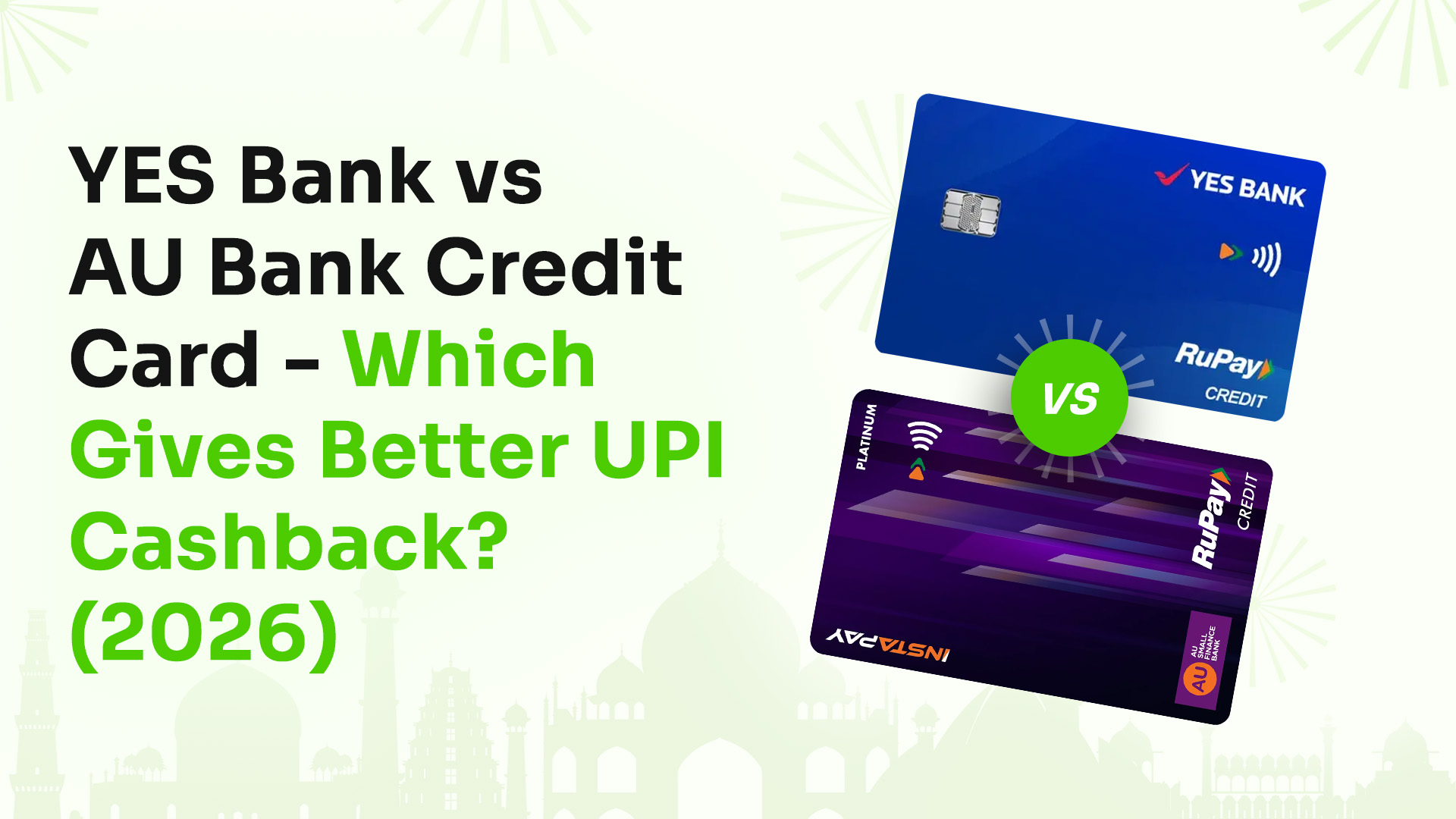
If you are looking for a credit card that works on UPI, your options come down to RuPay-network cards – and two of the most accessible issuers in this space are YES Bank and AU Small Finance Bank. Both offer RuPay credit cards that can be linked to UPI apps, both partner with fintech platforms for digital-first issuance, and both offer lifetime-free or low-cost options.
But the cashback rates, reward structures, fee models, and additional benefits differ in ways that matter for your monthly savings. This guide puts both banks side by side so you can pick the one that matches how you actually spend.
For a broader view of all available YES Bank options, see our complete YES Bank credit card guide [/blog/yes-bank-credit-cards/].
The Cards We Are Comparing
Both banks offer multiple credit card variants, but for a UPI-focused comparison, we are looking at the RuPay cards that most users will actually apply for.
From YES Bank:
– Klick card (issued via Kiwi) – the primary UPI-focused card
– POP Club – alternative with higher online rewards
From AU Small Finance Bank:
– AU Small Finance Bank RuPay credit card (issued via Kiwi) – the primary UPI-focused card
– LIT credit card – customisable card with RuPay variant
Both the YES Bank Klick and AU Bank RuPay cards issued through Kiwi share the same platform, but the underlying card terms, cashback structures, and benefits come from different issuing banks.
Head-to-Head Comparison
| Feature | YES Bank Klick (via Kiwi) | AU Bank RuPay (via Kiwi) |
| Network | RuPay | RuPay |
| Joining Fee | ₹0 | ₹0 |
| Annual Fee | ₹0 (lifetime free) | ₹0 (lifetime free) |
| UPI Scan & Pay Cashback | 1.5% | 1.5% |
| Online Payment Cashback | 0.5% | 0.5% |
| Neon Membership (paid tier) | 5% cashback on UPI above ₹1.5L annual spend | 5% cashback on UPI above ₹1.5L annual spend |
| Cashback Delivery | Direct to bank account | Direct to bank account |
| Lounge Access | 3/year (with Neon) | 3/year (with Neon) |
| Fuel Surcharge Waiver | 1% waiver (₹400–₹5,000 transactions) | 1% waiver (₹400–₹5,000 transactions) |
| Reward Points | 2 RP per ₹200 non-UPI spends | Varies by card variant |
| Interest Rate | 3.8% p.m. (approx.) | Varies – check issuer terms |
| Forex Markup | 2.75% | Varies by variant |
| Card Issuer | YES Bank (private sector) | AU Small Finance Bank (SFB) |
| Credit Limit Assessment | Based on income, credit profile, YES Bank criteria | Based on income, credit profile, AU Bank criteria |
Where YES Bank Has an Edge
Broader credit card ecosystem. YES Bank offers 20+ credit card variants across entry-level to super-premium tiers. If your income grows or your needs change, you can upgrade within the YES Bank ecosystem to cards like ELITE+, RESERV, or MARQUÉE, which offer higher rewards, lounge access, and lower forex markup. AU Bank’s credit card range, while growing, is not as extensive.
Reward points on non-UPI spending. The YES Bank Klick card earns 2 reward points per ₹200 on non-UPI spends (POS and online transactions not routed through UPI). These points can be redeemed through the YES Rewardz programme. This gives the card a small additional earning layer beyond UPI cashback.
More card upgrade paths. YES Bank’s tiered card structure means that as your spending and income grow, you have clear upgrade options with progressively better benefits. Moving from a Klick card to an ELITE+ or SELECT is a natural progression within the same bank.
YES Bank’s lounge access network on premium cards. If you eventually upgrade, YES Bank’s premium cards (MARQUÉE, RESERV) offer some of the best lounge access packages in the Indian market, including unlimited international visits on the MARQUÉE. For details, see our YES Bank credit card lounge access guide [/blog/yes-bank-credit-card-lounge-access/].
Where AU Bank Has an Edge
Small Finance Bank advantages. AU Small Finance Bank operates under a different banking licence, which can result in higher savings account interest rates and deposit rates compared to private banks. If you hold an AU Bank account, the overall banking relationship may offer better returns on your deposits.
Growing presence in Tier 2/3 cities. AU Bank has a strong branch network in Rajasthan and other semi-urban markets. For users in these areas, having a local banking relationship alongside the credit card can be more convenient for in-branch services.
LIT card customisation. AU Bank’s LIT credit card allows users to choose their reward categories, giving more control over where you earn the highest returns. If your spending is concentrated in specific categories, this customisation can outperform a flat-rate card.
For UPI Spending Specifically – Is There a Difference?
When both cards are accessed through the Kiwi platform, the core UPI experience is very similar. The 1.5% cashback rate on UPI Scan & Pay, the 0.5% rate on online payments, and the Neon membership benefits (2% cashback, 5% on milestone, lounge access) are consistent across both.
The practical differences for pure UPI usage are minimal. The choice between YES Bank and AU Bank for a Kiwi-issued card comes down to:
Credit limit. The credit limit you receive may differ because each bank uses its own underwriting criteria. Some users report receiving a higher limit from one bank versus the other based on their income profile and credit history.
Approval chances. If your application is declined by one bank, you may still be approved by the other. The underwriting models are independent, so having an option from two banks increases your chances of getting a card.
Banking relationship preferences. If you already have a savings account or other products with one bank, that may influence your preference due to easier bill payment, potential for relationship-based limit increases, or consolidated account management.
Beyond UPI – Other Features Worth Comparing
If your usage extends beyond UPI Scan & Pay, some differences become more relevant.
International Transactions
YES Bank credit cards charge 2.75% forex markup on the Klick card. AU Bank’s forex rates vary by variant. For frequent international spenders, checking the specific card’s forex markup is essential. Within the YES Bank ecosystem, upgrading to the RESERV (1.75%) or applying for the Uni card (0%) provides better international rates.
Credit Card Bill Payment
Both banks support standard payment methods including UPI, NEFT, net banking, and auto-debit. YES Bank’s IFSC code for credit card payments is YESB0CMSNOC. AU Bank uses its own IFSC code. For a detailed walkthrough of all YES Bank payment methods, see our YES Bank credit card bill payment guide [/blog/yes-bank-credit-card-payment/].
Charges and Fees
Both the Klick and AU RuPay cards issued via Kiwi are lifetime free. However, interest rates, late payment fees, and surcharge structures are set by each bank independently. For a complete breakdown of YES Bank’s charges, see our YES Bank credit card charges guide [/blog/yes-bank-credit-card-charges/].
Which One Should You Pick?
Here is the decision framework based on your situation.
Choose YES Bank Klick if:
– Want a clear upgrade path to premium cards (ELITE+, RESERV, MARQUÉE) within the same bank
– Already have a YES Bank savings account or plan to open one
– Want reward points on non-UPI spending in addition to UPI cashback
– May need lounge access in the future through a premium upgrade
Choose AU Bank RuPay if:
– Already have an AU Bank savings account with good deposit rates
– Live in an area with strong AU Bank branch presence
– Prefer AU Bank’s overall banking relationship
If you are starting fresh with no existing relationship with either bank, both cards deliver identical UPI cashback when issued through Kiwi. Apply for both and use whichever one you receive first, or whichever gives you a higher credit limit. There is no penalty for holding both cards simultaneously, and having two UPI-capable credit cards gives you a backup if one issuer has a server issue.
To learn how to set up either card for UPI payments, see our step-by-step UPI linking guide [/blog/how-to-link-yes-bank-credit-card-to-upi/].
Frequently Asked Questions
When both cards are issued through Kiwi, the UPI cashback rate is the same, 1.5% on Scan & Pay. The difference lies in the broader card ecosystem, upgrade options, and banking relationship benefits.
Yes. There is no restriction on holding credit cards from multiple banks. Many users hold both to maximise credit limits and have a backup for UPI payments.
Yes. Both YES Bank and AU Bank RuPay credit cards can be linked to Google Pay, PhonePe, Paytm, BHIM, and the Kiwi app.
Yes. Each bank has independent underwriting criteria. A rejection from YES Bank does not affect your application with AU Bank. However, the hard inquiry from the YES Bank application will be visible on your credit report.
Yes. The Neon membership benefits (2% UPI cashback, 5% on milestones, lounge access) apply equally regardless of whether your Kiwi card is issued by YES Bank or AU Bank.
YES Bank has a dedicated 24/7 credit card helpline at 1800-103-1212. AU Bank also has credit card support through their customer care lines. For Kiwi-specific issues (app, cashback, rewards), contact Kiwi support directly regardless of the issuing bank.
Ready to get started? Apply for the lifetime-free YES Bank Klick card through Kiwi and earn 1.5% cashback on every UPI payment. Check your eligibility → Yes Bank Credit Card