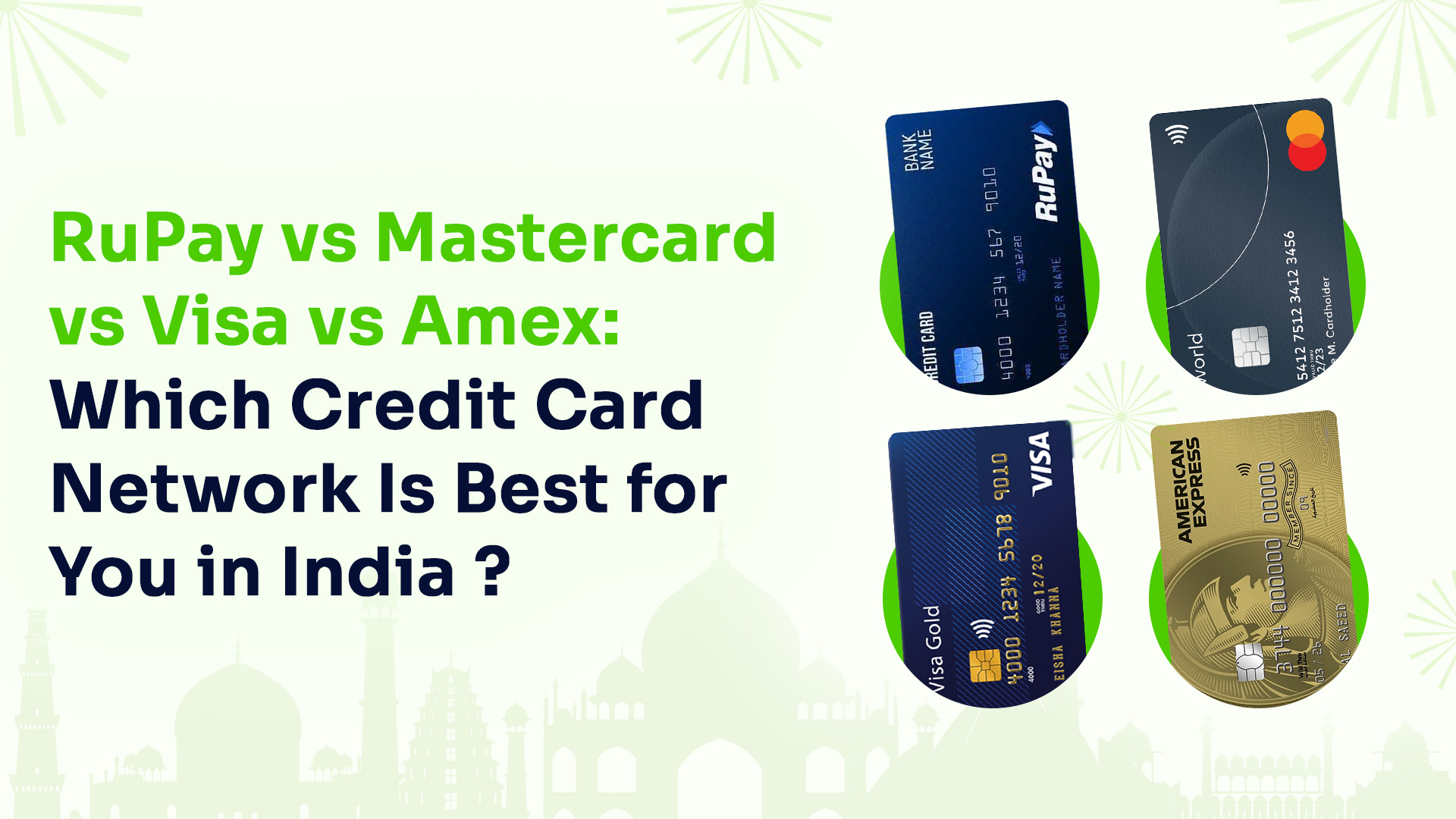
If you’re looking to pick a credit card in India in 2026, you must have come across these four big names— (RuPay), Mastercard, Visa, and American Express (Amex). But what really sets them apart? Which network should you choose according to your spending habits and lifestyle?
Let’s break down the key differences and similarities of these credit card giants, backed by the latest data, to help you decide.
Market Share and Penetration
- HDFC, SBI, ICICI, and Axis banks dominate the credit card issuance market in India, collectively holding over 70% of the total market share.
- HDFC Bank: Approx. 22% market share
- SBI Card: Around 19–20% market share
- ICICI Bank: About 14–16% market share
- Axis Bank: Roughly 10–14% market share
Most cards from these banks are issued on Visa and Mastercard networks, reflecting their strong ties with global payment giants and wide merchant acceptance in India and internationally.
- RuPay has grown rapidly in recent years, capturing around 16% of all credit card spending and over 25% of new credit cards issued in India, thanks to its integration with UPI and government backing.
- American Express holds a niche premium segment (~1-2% market) but is gaining popularity among high-income urban professionals.
Acceptance and Usability
| Network | Domestic Acceptance | International Acceptance | UPI Integration |
| RuPay | Widely accepted | Limited but growing | Full integration; supports UPI credit payments |
| Mastercard | Widespread | Nearly global (210+ countries) | No |
| Visa | Widespread | Nearly global (200+ countries) | No |
| Amex | Growing | Global, but fewer merchants than Visa/Mastercard | No |
RuPay focuses heavily on domestic acceptance and UPI integration, making it extremely convenient for Indian users. Its wide network and compatibility with popular UPI apps ensure easy accessibility even in Tier 2 and Tier 3 cities, where digital payments are growing rapidly. This makes RuPay a practical and inclusive option for users across urban and semi-urban India.
Fees and Charges
- RuPay cards typically have lower processing and transaction fees for banks and merchants, which often translates to lower joining and annual fees for users.
- Visa and Mastercard generally charge higher fees due to their international networks, reflected in slightly higher user costs but wider acceptance and premium features.
- Amex cards tend to have higher fees but offer exclusive premium rewards, concierge services, and lifestyle privileges.
Speed and Security
- RuPay processes transactions domestically, resulting in faster approvals and enhanced security as data does not leave India.
- Mastercard and Visa transactions sometimes require international data routing, which can add latency and jurisdictional complexity but provide extremely robust global security frameworks.
- All four networks have strong security protocols including EMV chips, tokenization, and AI-based fraud detection.
Rewards and Benefits
- RuPay cards now offer competitive rewards and cashback schemes, especially on UPI payments, groceries, and fuel. This means users can save more on everyday expenses while enjoying the convenience of seamless UPI transactions. Whether it’s paying at local stores, refueling, or shopping online, every spend can earn cashback or reward points, making RuPay cards a smart choice for regular users looking to maximize value from daily payments.
- Visa and Mastercard cards provide varied rewards across travel, dining, shopping, and premium lifestyle benefits, designed for Indian and international usage.
- Amex offers luxury and exclusive rewards programs targeted at affluent users, including airport lounge access and high-value partnerships.
Who Should Pick What?
| User Profile | Recommended Network |
| Primarily domestic user focused on cost efficiency | RuPay, due to low fees and full UPI integration |
| Frequent international traveler | Visa or Mastercard, for superior global acceptance |
| Premium lifestyle and luxury seeker | American Express, for exclusive rewards and privileges |
| Heavy online shopper and UPI user | RuPay or Visa/Mastercard co-branded cards specialized for e-commerce |
What’s New and More Relevant in 2026
1. UPI Credit Is No Longer an Experiment
UPI-linked credit cards have moved from pilot to habit. RuPay leads this shift. More merchants now allow UPI Credit on RuPay cards. Small-ticket spends dominate. ₹100–₹500 payments now earn rewards.
For many users, this has replaced debit cards entirely.
2. Credit Cards Are Used Like Daily-Pay Tools
In 2026, Indians don’t “save” cards for big purchases.
They use them for:
- Groceries
- Local shops
- Auto, fuel, food delivery
- Subscriptions
This trend favours low-fee, high-frequency networks. RuPay benefits the most here. Visa and Mastercard still win for higher-value spends.
3. RBI Push on Data Localisation Matters More Now
Data sovereignty is no longer a backend topic. Domestic routing is now a trust factor. RuPay processes transactions fully within India. This reduces latency and regulatory risk.
For banks, this lowers compliance friction. For users, it improves transaction success rates.
4. International Acceptance Gap Is Shrinking (Slowly)
RuPay’s global acceptance is improving via partnerships.
But in 2026:
- Visa
- Mastercard
still dominate overseas.
If you travel even once a year, keep one of these.
5. Amex Is Betting on Experiences, Not Acceptance
American Express has doubled down on lifestyle value.
In 2026, Amex wins on:
- Curated dining programs
- Premium travel insurance
- Invite-only experiences
It is less about where you can swipe. More about what you unlock.
6. Co-Branded Cards Are Doing the Heavy Lifting
Banks now push use-case cards, not generic ones.
Examples:
- E-commerce focused cards
- Fuel + grocery hybrids
- Travel-only cards
Network matters less here. Reward design matters more.
7. One Network Is No Longer Enough
The smartest users in 2026 hold two cards.
Typical combo:
- RuPay for UPI + daily spends
- Visa or Mastercard for travel and large purchases
This setup maximises rewards. It also reduces decline risk.
Final Update for 2026
Choosing a card network is no longer about prestige. It’s about how often, how small, and where you spend.
- RuPay fits India-first, UPI-heavy lifestyles
- Visa & Mastercard power global flexibility
- Amex rewards premium experiences
In 2026, the best card is the one you actually use every day.