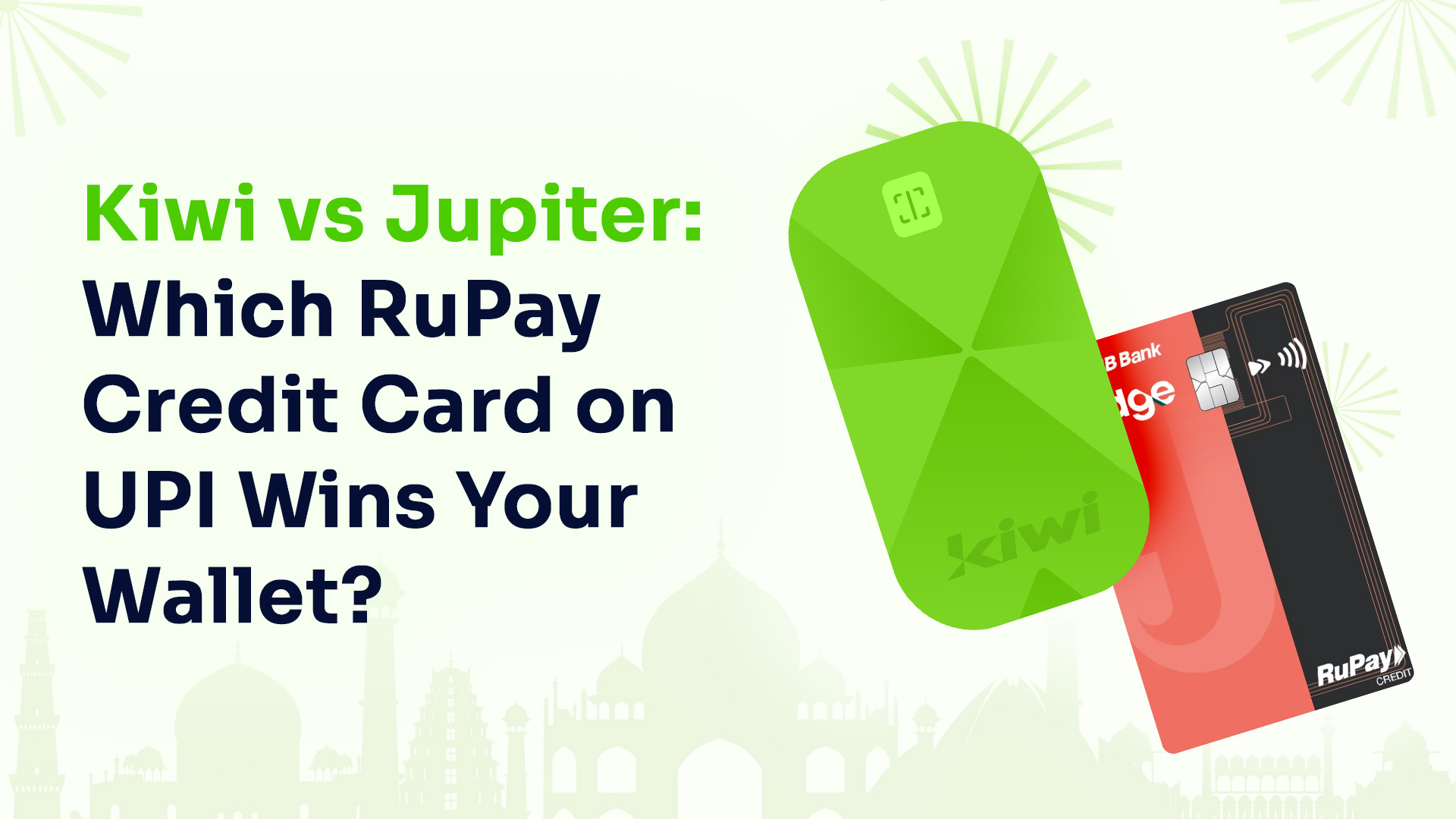
If you’re paying via UPI QR—especially for everyday needs—and want the flexibility and rewards of a credit card, you’re in the right place. Let’s compare Kiwi and Jupiter Edge+ RuPay Credit Card, focusing on UPI integration, rewards, ease of use, and overall value.
1. UPI Credit Card Integration
Kiwi:
- Provides a RuPay Credit Card you can link in the Kiwi app, enabling credit-enabled UPI payments at any standard merchant QR (except where credit acceptance is disabled).
- Seamless integration designed for everyday offline spending.
Jupiter Edge+ (RuPay variant):
- Also supports RuPay credit-on-UPI through Jupiter’s platform.
- Integration exists, but user feedback highlights occasional glitches in linking steps or UPI app recognition.
Verdict: Both support RuPay on UPI—but Kiwi is built specifically around this workflow, while Jupiter adds it as one of many features.
2. Rewards & Cashback
Kiwi:
- Offers 1.5% flat cashback on eligible everyday offline UPI spends.
- Premium plan (Neon, ₹999/yr) unlocks tiered cashback: 3% at ₹50K annual spend, 4% at ₹1L (minus prior cashback), 5% at ₹1.5L (minus prior cashback).
- Cashback is real money, directly banked—no points, no conversions.
Jupiter Edge+:
- Lets you pick one category—shopping, dining, or travel—for 2% cashback. Other spends earn 0.4%.
- Rewarded as “Jewels” that need redemption in-app or via bank account, adding complexity and potential delays.
Verdict: Kiwi’s structure is simpler and clearer. Jupiter offers flexibility but less reward on non-chosen categories and needs redemption steps.
3. Fees & Access
Kiwi:
- Lifetime-free card. No joining fee, no annual fee.
- Optional Neon membership for benefits like lounge access.
Jupiter:
- Also no joining or annual fees on Edge+.
- Includes other premium features like a clean UI and spending insights—but benefits depend on achieving spend thresholds (e.g., free lounge access on high spend).
Verdict: Both are no-fee basic cards. Kiwi’s simplicity wins for UPI value, while Jupiter’s premium features require more dependent behavior.
4. Lounge Access & Travel Perks
Kiwi:
- Neon members get three complimentary domestic lounge entries/year.
Jupiter Edge+:
- Lounge access available—typically one session per quarter—but requires meeting a spend threshold in that quarter.
Verdict: Kiwi delivers clear lounge benefits via paid subscription, whereas Jupiter’s access is spend-driven and rolling—less predictable.
5. Everyday Usage & Simplicity
Kiwi:
- Designed for daily usage at small merchants—kirana, salons, cafés, pharmacies, etc.—via UPI credit.
- Billing and redemption are straightforward and transparent.
Jupiter:
- Offers UPI credit as part of a broader digital banking experience.
- Features like spending analytics, savings vaults, and insights complement card usage—but the UPI path isn’t always front and center.
Verdict: Kiwi is optimized for checkout simplicity; Jupiter is more of a digital bank with UPI credit as one feature among many.
6. User Voices (Reddit Snippets)
“Kiwi’s flat rate makes tracking a breeze. Jupiter’s jewels barely equated to 0.8%, so Kiwi edges out.”
“Redemption with Jupiter can feel like a maze. Kiwi’s cashback goes straight to your bank—simple.”
— Indian credit card users (2025)
Quick Comparison Table
| Feature | Kiwi (RuPay UPI Credit) | Jupiter Edge+ (RuPay UPI Credit) |
| UPI Credit Integration | Seamless via Kiwi app | Functional, some friction reported |
| Cashback Structure | 1.5% flat; up to 5% with Neon | 2% in chosen category; 0.4% elsewhere |
| Ease of Redemption | Instant, real cashback | Requires Jewel conversion within app |
| Fees | Free; Neon ₹999/year | Free basic tier; features require spend |
| Lounge Access | 3/year with Neon | 1/quarter upon spend threshold |
| UX Focus | Checkout-first, minimal UI | Full digital banking experience |
Final Verdict
If your day starts with scanning Spices at the local market, paying with credit, and ending with transparent rewards—Kiwi nails it.
If you’re looking for a full banking experience with analytics, vaults, and occasional travel perks—and don’t mind managing points—Jupiter brings more features.
Want help mapping which one aligns with your monthly spends or lifestyle habits? Let me know—I can tailor the next comparison blog around your use case.
FAQs: Kiwi vs Jupiter RuPay Credit Cards
1. Do both Kiwi and Jupiter offer RuPay cards that can be linked to UPI?
Yes, both issue RuPay credit cards that can be linked to UPI for merchant QR payments. Kiwi is designed primarily for this use case, while Jupiter integrates it into a wider digital banking experience.
2. Which card gives better cashback on everyday UPI spends?
Kiwi offers 1.5% flat cashback (up to 5% with Neon). Jupiter gives 2% only in one chosen category and just 0.4% on other spends.
3. How is the cashback credited in Kiwi vs Jupiter?
Kiwi gives real cashback directly to your bank account. Jupiter rewards are in “Jewels,” which need to be redeemed within the app or transferred to the account.
4. Which one is better for lounge access?
Kiwi’s Neon membership includes three domestic lounge visits per year. Jupiter offers one per quarter, but only if you meet a spend requirement.
5. Are both cards free to own?
Yes. Both Kiwi and Jupiter cards are lifetime free with no joining or annual fee. Kiwi’s premium Neon plan costs ₹999/year for higher cashback and lounge access.
6. Can I use these cards abroad?
Both cards are RuPay-based. International acceptance for RuPay depends on partner networks like Discover, Diners, or JCB. For frequent international travel, Visa/Mastercard cards still have wider acceptance.
7. Are all UPI QR transactions eligible for cashback?
No. Both cards exclude certain categories like utilities, government payments, fuel, tolls, jewelry, and professional services. Rewards apply only on eligible everyday spends.